http://www.ucl.ac.uk/sargon/essentials/kings/shalmaneserv/
========================
===========================
Shalmaneser V, king of Assyria (726-722 BC)
The chosen heir of his father Tiglath-pileser III (744-727 BC), Shalmaneser V was king of Assyria and king of Babylon. But his reign lasted less than five years and ended in a succession war which brought his brother, Sargon II (721-705 BC), to power.
Ululayu, the crown prince
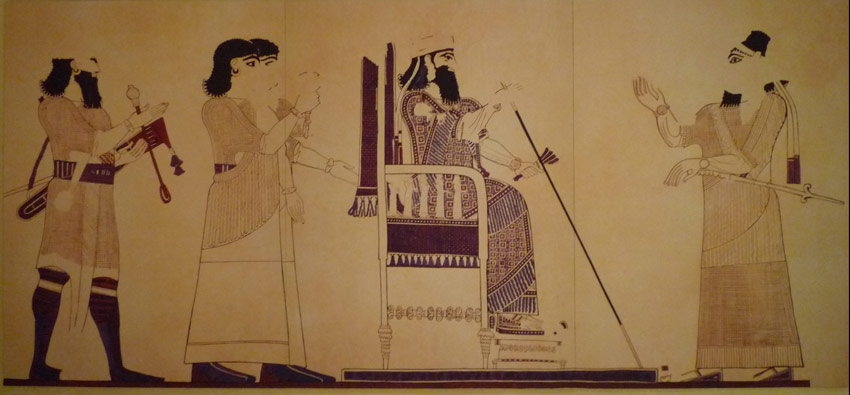
This scene from the painted wall decoration of the 8th century Assyrian palace ofHadattu PGP (modern Arslan Tash) in Syria shows the seated king Tiglath-pileser IIIreceiving a report from the crown prince who can be identified by his distinctive headdress. The man depicted is therefore Ululayu, who eventually succeeded to the Assyrian throne as king Shalmaneser V. Reconstruction on display in the Louvre; photo by Karen Radner.View large image.
As crown prince, the future Shalmaneser V was known as Ululayu. This fairly common name was certainly his birth name and means "born in Elul (i.e. the sixth month of the Assyriancalendar TT ; c. August-September)". We do not know when Ululayu was promoted to the position of heir apparent to the Assyrian crown but five letters from the royal correspondencefound at Kalhu in which he reports to his father, the king, attest to his activities during that period.
decades later by Sennacherib (704-681 BC) to his father and king, Sargon II: all of the crown princes' letters - but only these - include the phrase "Assyria is well, the temples are well, all fortresses of the king are well" and there is also an overlap in their remit as far as it emerges from the surviving correspondence. It is likely that this has less to do with their personal interests and more with the office of crown prince which they both held, which was the second highest position within the Assyrian stateafter the king, outranking even the Commander-in-Chief, the Chief Cupbearer and the Treasurer.
Ululayu primarily deal with matters concerning the palace household in the king's absence: arranging for the palace to have sufficient supplies, for example of ice which was collected on the mountain peaks to the north and east of central Assyria and transported to Kalhu by river; co-ordinating the protection details for the queen's travels; and receiving ambassadorial delegations visiting the royal palace. Diplomatic relations seem to be one of his major concerns as we also see him monitor the reception of Assyrian state gifts abroad. The known letters show him dealing notably with Assyria's western vassal kingdoms: Carchemish, Kummuhi (Commagene), Gurgum, Que, Sam'al, Ashdod and Moab PGP . He must have acquired a good knowledge of these regions during that time, an excellent preparation for the military campaigns which he conducted against some of these states as king of Assyria.
================================
After Tiglath-pileser's natural death, Ululayu ascended to the throne without a challenge. Like his father, he ruled not only as king of Assyria but also as king of Babylon. Instead of his everyday name he adopted a glorious throne name, Shalmaneser, meaning "the god Salmanu is foremost". Such a name was only fit for a ruler of Assyria and invoked the memory of distinguished predecessors such as the 13th century king Shalmaneser I and Shalmaneser III (858-824 BC) - both well known for their conquests of regions to Assyria's west. The new king also adopted this political programme and continued the subjugation of the west initiated by his father.
Because of his short reign, very few official documents commissioned by Shalmaneser V survive: a brick inscription from Apku PGP (modern Tell Abu Marya) shows that he undertook building work in this north Assyrian city but otherwise only a set of lion-shaped weights fromKalhu bears the official inscriptions of this king. Nevertheless, circumstantial evidence allows us to conclude that three new provinces were created in the west in Shalmaneser's reign:Samaria PGP , the southern part of the kingdom of Israel, and Sam'alla PGP and Que PGP in the region of Adana in south-eastern Turkey.
However, in 722 BC, Sargon replaced his brother Shalmaneser as king of Assyria amidst murky but decidedly violent circumstances. Shalmaneser's fate is unknown but that the succession was awkward is plainly indicated by the fact that Sargon's voluminous body of royal inscriptions contains just one reference to his predecessor: in it, Sargon has his brother condemned as a godless tyrant who had robbed the city of Assur of its traditional privileges. One can safely assume that unless Shalmaneser managed to flee to one of Assyria's enemy states and found asylum there (for which there is no indication at all), he met his death in the struggle for the kingship of Assyria.

Walang komento:
Mag-post ng isang Komento